Nuclear Fusion
The Spark.
We bring atoms together — fusion — instead of splitting them apart (fission). Two nuclei slam in, become one, and release a burst of energy brighter than the core of the sun.


Our Technology
In 1776, Thomas Paine's Common Sense made the complex case for liberty accessible to every colonist. We believe fusion science deserves the same treatment.
We bring atoms together — fusion — instead of splitting them apart (fission). Two nuclei slam in, become one, and release a burst of energy brighter than the core of the sun.
We use two isotopes of hydrogen — deuterium and tritium. Heated to extreme temperatures, they fuse into helium, kicking out a neutron and a flash of energy.
That energy heats a liquid blanket, which drives a steam turbine, which generates electricity. No combustion. No long-lived radioactive waste.
Our Reactor
Plasma-Jet-Driven Magneto-Inertial Fusion. Yes, it’s a mouthful. Here’s what it actually means.
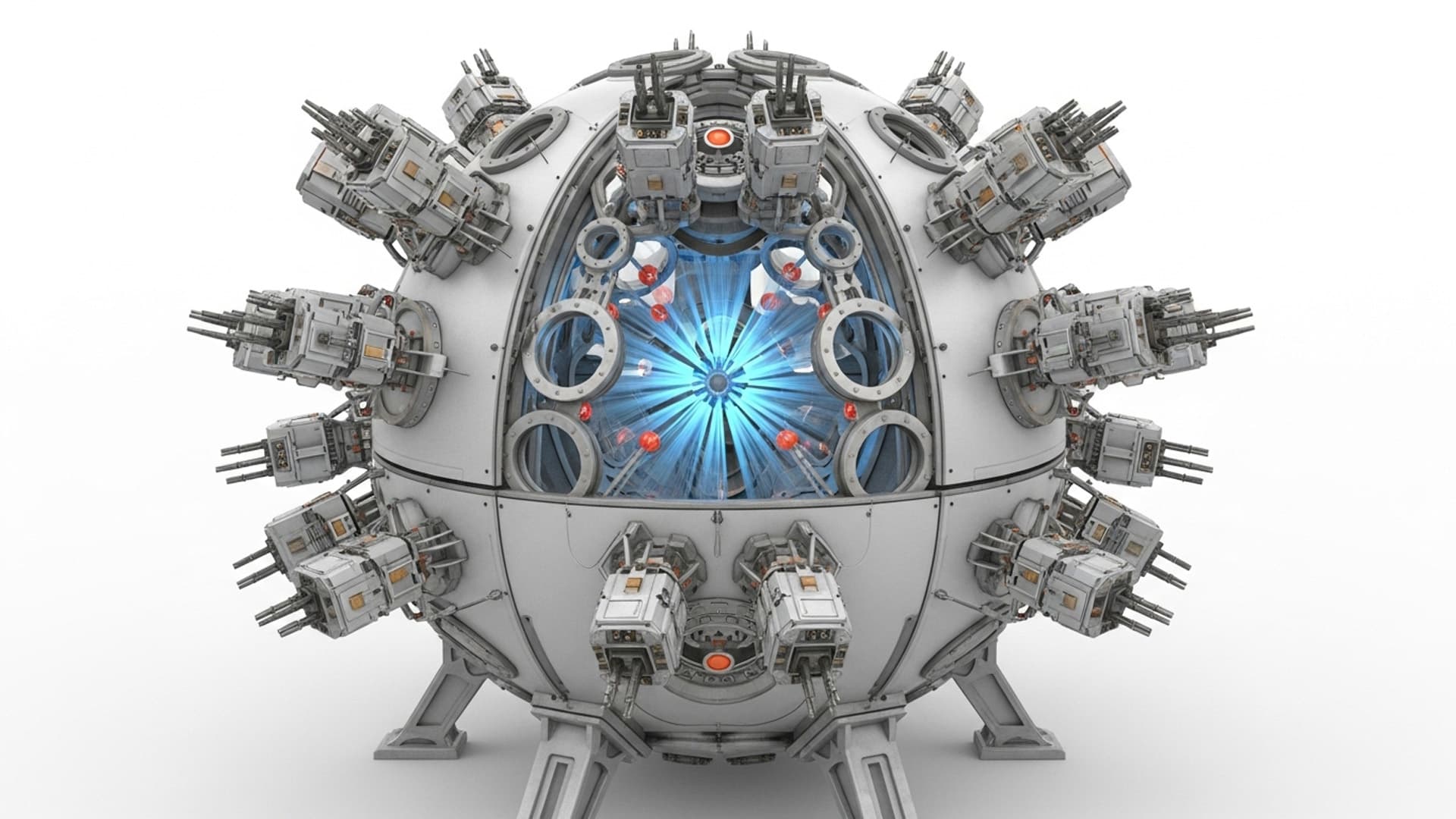
Born from the Plasma Liner Experiment (PLX) at Los Alamos National Laboratory and backed by ARPA-E, our reactor is a hybrid that combines the best of magnetic confinement and inertial confinement fusion. We don’t use building-sized superconducting magnets or stadium-scale laser arrays. We use plasma guns.
Plasma-Jet-Driven Magneto-Inertial Fusion. Instead of trying to hold a star in place, we ignite it dynamically using a process called PJMIF. Here is how it works in five steps.
Architectural Advantage
A major hurdle for other fusion concepts is that their hardware sits right next to the fusion reaction, causing it to degrade and fail. Liberty Fusion has an architectural advantage called Standoff: our plasma guns are mounted on the perimeter of the chamber, meters away from the fusion event.
No hardware in the blast zone means we can fire rapidly and repeatedly — the foundation of continuous baseload power.
The Hardware
Instead of building-sized lasers, our engine is driven by an array of coaxial plasma guns that fire plasma jets at over 100 km/s. The same gun technology is already being used as a testbed for advanced materials testing — subjecting samples to extreme thermal and plasma environments that simulate the conditions faced by next-generation aerospace and defense systems.
This generates revenue and proves hardware reliability well before our reactors connect to the grid.
The Science
Liberty Fusion’s technology is built on decades of peer-reviewed research conducted at Los Alamos National Laboratory, funded by ARPA-E, and published in leading journals. 40 publications spanning plasma liner formation, jet merging dynamics, magnetized target compression, semi-analytic gain models, and reactor concept design.
The most recent and complete simulation study of PLX, modeling all three phases (target formation, liner formation, and compression) with three codes suited to each regime. It finds that the experiment can form a preheated, magnetized target and a converging liner shell that compresses the target to fusion-relevant conditions, with temperatures exceeding one kiloelectronvolt.
Find the paperA look back at two ARPA-E fusion programs that helped shape today's private fusion landscape: BETHE (2019), aimed at advancing more lower-cost fusion approaches toward higher maturity, and GAMOW (2020), aimed at the materials, fuel-cycle, and enabling technologies commercial fusion will need. It also reviews the related project cohorts and the agency's technology-to-market work from 2018 to 2022.
Find the paperA recent experimental milestone reporting the formation of a more complete spherical liner from merging jets, with measurements of its structure and convergence. Demonstrating an actual spherical liner, rather than just a section, is a direct step toward the full PJMIF geometry.
Read the paperStudies fast magnetosonic waves, magnetized pressure waves launched when a compact, self-contained blob of magnetized plasma (a compact toroid) is injected into a background. The work bears on how magnetized plasma carries energy and field, relevant to forming and compressing the magnetized target.
Read the paperMeasures how different ion species mix and diffuse across a plasma shock when more than one kind of ion is present. Because real liners and fuel involve mixed species, knowing how they separate or blend at a shock front improves the accuracy of liner and compression models.
Read the paperA study weighing two outcomes when jets collide: forming a sharp shock versus smearing the collision out. Which one you want depends on the goal, since a clean shock can heat the fuel while too much shock can spoil liner uniformity, so understanding the trade-off informs the design.
Read the paperDevelops computational scaling laws connecting reactor-scale design choices to the fusion yield a plasma-liner machine would produce. Such laws let engineers estimate how much driver energy and what liner parameters are needed to hit a target power level, guiding reactor design.
Read the paperA diagnostic advance using several fast cameras at once to image jets and the forming liner from multiple viewpoints. Multi-angle imaging turns liner uniformity from something inferred into something directly seen, making it far easier to spot and correct asymmetries.
Read the paperKinetic simulations of jet merging when the plasma is strongly magnetized (a large Hall parameter), so the magnetic field noticeably steers the particles. This regime matters for the magnetized target and the inner liner, where field effects change how cleanly the jets merge.
Read the paperReports detailed measurements of a partial spherical liner formed from merging jets: its density, uniformity, and how closely it follows the converging shape predicted by simulation. Results like these are the experimental proof that the jet-merging route can produce a usable liner.
Read the paperFocuses on the other half of PJMIF: the warm, magnetized fuel target waiting at the center for the liner to compress. It examines how to form a target with the right density, temperature, and embedded magnetic field so that, once squeezed, it can reach fusion conditions.
Read the paperA simulation campaign testing how sensitive the liner is to real-world imperfections, such as small differences in jet mass or timing between guns. Quantifying how much variation the liner can tolerate before its symmetry degrades sets the engineering tolerances for firing dozens of guns together.
Read the paperAn extension of the ion-heating work to jets merging at an angle at very high speeds. Because a real liner is built from many oblique mergers, measuring how much the ions heat in that geometry refines predictions of the liner's temperature and quality.
Read the paperA comprehensive overview of the PJMIF concept itself, the approach Liberty Fusion builds on. It explains the full chain (guns fire jets, jets merge into an imploding liner, the liner compresses a magnetized fuel target) and reviews the supporting physics, hardware, and reactor outlook in one place.
Read the paperDirect measurements of how much ions heat up when plasma jets collide and form a shock. Since the energy that ends up in the fuel as heat is what drives fusion, quantifying ion heating in these shocks is central to predicting how well a liner compresses and warms its target.
Read the paperLays out the physics targets a smaller, lower-cost liner experiment must hit to be meaningful: which parameters have to be reached for the results to extrapolate toward a reactor. It is essentially the design rationale for testing the concept affordably before scaling up.
Read the paperDescribes an experiment that builds and measures a wedge, or section, of a full spherical liner using a subset of the guns. Studying a representative slice is a practical way to test liner uniformity and merging physics before committing to a complete spherical array.
Read the paperA fast, semi-analytic model of the entire PJMIF process, from liner formation through compression and burn. Rather than a heavy simulation, it links physics-based equations to predict performance across many design choices at once, the kind of tool used to scan parameters and find promising reactor operating points.
Read the paperA community overview of magneto-inertial fusion as a whole, the family of approaches that compress magnetized plasma at speeds between magnetic and inertial fusion. It surveys the main variants, including plasma-liner and solid-liner schemes, their progress, and the open questions, placing PJMIF in its broader context.
Read the paperA review of the wider physics that merging-jet experiments can probe, not only liner formation but shocks, instabilities, and high-energy-density plasma states. It positions the plasma-gun platform as a flexible tool for fundamental plasma science alongside its fusion goal.
Read the paperA broad survey of the conditions under which magnetized target fusion can ignite. By scanning fuel density, temperature, magnetization, and size, it maps the design space where ignition is possible, showing that MTF occupies a useful middle ground between magnetic and inertial fusion and pointing to the targets worth pursuing.
Read the paperAn experiment tracking how the interaction between two plasma jets changes as conditions shift from collisionless to collisional. Mapping that transition pins down exactly where jets stop passing through each other and start forming shocks, the boundary that governs how a liner takes shape.
Read the paperA modeling study estimating the fusion energy gain achievable with a plasma-liner-driven MIF reactor. By stepping through the implosion and burn, it identifies combinations of liner energy, fuel, and magnetization that could yield more energy out than in, supporting the case that the concept can reach reactor-relevant gain.
Read the paperExperimental confirmation that, under the right conditions, obliquely merging jets form a true collisional shock rather than simply sliding past each other. Knowing which regime the jets are in, interpenetrating or shocking, directly affects how uniform and dense the merged liner becomes.
Read the paperKinetic (particle-in-cell) simulations of two jets colliding head-on fast enough that the particles barely collide in the ordinary way. The work explores whether such collisions form a collisionless shock, a regime important both for liner physics and for laboratory studies of astrophysical shocks.
Read the paperDerives simple scaling formulas linking a liner's starting conditions to the pressure and state it reaches at stagnation. Clean scaling laws let designers estimate performance quickly and extrapolate from small experiments toward reactor-scale liners without running a full simulation for every case.
Read the paperA controlled experiment on what happens where two jets meet at an angle, the basic merging event repeated all over a liner. It measures the density and thickness of the stagnation layer that forms between them, revealing whether merging jets pile up sharply or slide through each other, which sets how clean the resulting liner is.
Read the paperA reassuring result for the whole concept: simulations indicate that even a liner assembled from discrete jets tends to smooth out and grow more spherical as it converges. Because compression quality depends on symmetry, a self-smoothing tendency makes the jet-merging strategy more forgiving of imperfect starting conditions.
Read the paperA follow-on to earlier one-dimensional liner simulations, this time with more detailed atomic-physics and equation-of-state modeling of the imploding gas. Better material data sharpens the predictions of how a liner heats, radiates, and stagnates, improving confidence in the pressures the approach can reach.
Read the paperA diagnostic describing a multi-channel laser interferometer that measures plasma density along several lines of sight at once. Looking through a jet from multiple angles at the same moment lets researchers reconstruct its density profile as it moves, a key input for validating jet and liner simulations.
Read the paperMeasurements of the individual plasma jets produced by railgun-style guns: their density, speed, and how they spread and cool as they travel. Since the liner is only as good as the jets that form it, characterizing a single jet in detail is the first step toward predicting how dozens of them will merge.
Read the paperA framing paper for the whole PJMIF approach: use a spherical, imploding plasma liner as a “standoff” driver, so the guns sit far from the reaction and survive. It reviews the concept, the supporting physics, and the experimental program (PLX) set up to test whether converging jets can form a good enough liner.
Read the paperA one-dimensional radiation-hydrodynamics study of how an imploding spherical liner stagnates at the center, and how the peak pressure scales with the liner's starting mass, speed, and composition. It found that liners carrying a few hundred kilojoules of kinetic energy could briefly reach roughly megabar pressures, an early benchmark for what the approach can deliver.
Read the paperAn overview of the measurement suite built for the Plasma Liner Experiment (PLX) at Los Alamos. To check whether merging jets actually form a clean, symmetric liner, you have to measure density, velocity, and structure on microsecond timescales. This describes the interferometry, imaging, and spectroscopy assembled to do exactly that.
Read the paperA hardware paper on an improved coaxial plasma gun. By shaping the gap between electrodes and injecting a plasma “armature” for the current to push on, the design launches dense, fast, repeatable jets while avoiding blow-by. This is the kind of gun a plasma-liner machine needs to fire reliably, shot after shot.
Read the paperA theoretical look at how a tangled, random magnetic field behaves when a plasma is compressed. Because the field threads the fuel during a liner implosion, its tension and pressure change the energy balance of the squeeze. The work clarifies how that magnetic energy scales as the plasma is compressed.
Read the paperOne of the first quantitative looks at whether plasma-liner-driven MIF can pay off energetically. Using reduced models, it estimates how long the compressed fuel stays confined and how much fusion energy a liner implosion could release relative to the energy put in, and maps the conditions under which net gain looks plausible.
Read the paperA two-dimensional magnetohydrodynamic study of “blow-by,” a failure mode in coaxial plasma guns where the driving current races ahead of the plasma instead of pushing it cleanly. Avoiding blow-by matters because these guns are the launchers that fire the jets used to build the liner, and the work clarifies the conditions that trigger it.
Read the paperAn early proposal and physics case for forming a plasma liner from a spherical array of converging plasma jets, the idea at the heart of PJMIF. It sets out why merging many high-speed jets into a single imploding shell is a promising, standoff way to compress a fusion target, and what experiments would be needed to test it.
Read the paperA foundational survey of magnetized target fusion (MTF), the hybrid family that PJMIF belongs to. Instead of compressing cold, dense fuel like pure inertial fusion, MTF compresses a warm, pre-magnetized plasma. The embedded magnetic field slows heat loss during the squeeze, so the fuel can reach ignition at lower densities and gentler implosion speeds, which eases the demands placed on the driver.
Read the paperForming and imploding the spherical plasma liner — symmetry, structure, scaling.
The most recent and complete simulation study of PLX, modeling all three phases (target formation, liner formation, and compression) with three codes suited to each regime. It finds that the experiment can form a preheated, magnetized target and a converging liner shell that compresses the target to fusion-relevant conditions, with temperatures exceeding one kiloelectronvolt.
Up Next
How fusion stays safe by design, and what the world's leading authorities say.
For the Curious